
You’ve booked your first lifestyle cruise, researched the logistics, and planned your packing list. But as the departure date approaches, you’re feeling something deeper than typical travel jitters. The emotional weight of stepping into this new social world feels significant—and that’s completely normal. This lifestyle cruise social guide focuses not on what to pack, but on preparing your heart and mind for genuine human connection.
Quick Takeaways:
- First-timer anxiety is universal—every lifestyle cruiser has felt it
- Authentic connection matters more than “working the room”
- Emotional preparation is just as important as physical preparation
- Vulnerability creates deeper bonds than perfectly rehearsed conversations
- Post-cruise emotional processing helps integrate your experience
Table of Contents
Understanding Your Pre-Cruise Emotions: You’re Not Alone
If you’re experiencing a cocktail of excitement, nervousness, anticipation, and outright fear before your first lifestyle cruise, you’re in good company. These feelings aren’t signs you’ve made the wrong decision—they’re indicators that you’re about to do something meaningful and potentially transformative.
The Vulnerability of Showing Up Authentically
Unlike a typical vacation where you can hide behind tourist activities, lifestyle cruises invite your authentic self to emerge. This vulnerability feels exposing. You might wonder: Will people like the real me? What if I’m not interesting enough? What if I don’t fit the social dynamics?
Here’s the truth that veteran lifestyle cruisers know: everyone feels this way before their first cruise. The couples who look effortlessly confident at embarkation? They were nervous too. The difference is they’ve learned that vulnerability creates connection, not distance.
Common Emotional Concerns Before Your First Cruise
Research from lifestyle cruise communities reveals these top emotional concerns among first-timers:
- Social anxiety: “What if I can’t start conversations or seem awkward?”
- Body image worries: “Will I be judged for how I look?”
- Comparison fears: “What if everyone is more experienced/attractive/confident than me?”
- Partner dynamics: “How will this experience affect our relationship?”
- Rejection sensitivity: “What if people aren’t interested in connecting with us?”
- Authenticity pressure: “Should I act differently than my everyday self?”
Acknowledging these fears doesn’t make them disappear, but it removes their power to control your experience. Let’s address each one with practical emotional preparation strategies.

Preparing Your Heart: Emotional Readiness Strategies
Reframe Your Intentions: Connection Over Conquest
The single most important mental shift you can make is changing your goal from “meeting lots of people” to “making genuine connections with a few.” Quality trumps quantity on lifestyle cruises. One meaningful conversation with a couple you truly click with creates more value than superficial small talk with dozens.
Ask yourself before the cruise: What would make this experience feel successful emotionally? For many first-timers, the answer isn’t “played with X number of people” but rather “felt accepted,” “had vulnerable conversations,” or “discovered new aspects of myself and my partner.”
Practice Self-Compassion Before You Board
Start building your self-compassion muscles now. When anxious thoughts arise—”I’m not attractive enough,” “I’ll say something awkward,” “People will reject us”—respond with kindness rather than criticism.
Try this reframing exercise:
- Anxious thought: “What if I’m too nervous to talk to anyone?”
- Self-compassionate response: “It’s normal to feel nervous in new social situations. I can start with just one conversation and see how it goes. My nervousness shows I care about connecting authentically.”
Self-compassion doesn’t eliminate nervousness, but it prevents that nervousness from spiraling into self-sabotage.
Discuss Emotional Boundaries with Your Partner
If you’re attending as a couple, have deep conversations about emotional—not just physical—boundaries before the cruise. Discuss:
- What if one of you connects strongly with someone and the other doesn’t?
- How will you handle jealousy if it arises?
- What’s your signal for “I need to reconnect with you”?
- How much solo exploration feels comfortable versus staying together?
- What happens if you’re both attracted to different people?
These conversations feel vulnerable but they create safety. When you know your partner understands your emotional landscape, you can explore with more freedom.

Overcoming Social Anxiety on Your Lifestyle Cruise
When Introversion Meets the Lifestyle
You don’t need to be an extrovert to thrive on a lifestyle cruise. Many successful lifestyle cruisers identify as introverts who’ve learned strategies for meaningful social interaction without exhaustion.
Introvert-friendly cruise strategies:
- Start small: Set a goal of one meaningful conversation per day, not ten surface-level chats
- Use structured activities: Join organized games or excursions where conversation happens naturally
- Take recharge breaks: Return to your cabin between social activities to restore energy
- Embrace deeper conversations: Ask thoughtful questions that move past small talk quickly
- Find other introverts: They’re everywhere, often in quieter spaces or at the edges of large gatherings
Managing Social Anxiety in High-Stimulus Environments
Theme night parties with 200+ people, loud music, and sensory overload can trigger anxiety even in socially confident people. Recognize that anxiety is your nervous system responding to unfamiliar stimuli, not a judgment on your ability to “handle” the lifestyle.
In-the-moment anxiety management techniques:
- The 5-4-3-2-1 grounding technique: Name 5 things you see, 4 you can touch, 3 you hear, 2 you smell, 1 you taste
- Box breathing: Breathe in for 4 counts, hold for 4, out for 4, hold for 4. Repeat 4 times.
- Physical anchor: Hold your partner’s hand, touch your necklace, or find a physical sensation to ground you
- Permission to leave: Remind yourself you can leave any space at any time. Often just knowing you can leave reduces the urge to actually do so
- Find quiet zones: Most cruise ships have quieter decks, cafes, or lounges away from main party areas
The Power of “I’m New Here”
Don’t hide your first-timer status—use it as a social superpower. The phrase “This is our first lifestyle cruise” opens doors:
- Veteran cruisers often love helping newcomers and sharing advice
- Other first-timers immediately bond over shared nervousness
- It gives people context for your tentative approach
- It invites others to share their first-time stories, creating instant connection
Vulnerability about being new creates connection faster than pretending expertise you don’t have.
Building Authentic Connections: The Heart of the Experience
What Makes Lifestyle Cruise Friendships Different
There’s something unique about connections formed on lifestyle cruises. The combination of shared values, vulnerability, and the time-limited nature of the experience creates surprisingly deep bonds quickly.
Unlike typical vacation acquaintances, lifestyle cruise friendships often feature:
- Accelerated intimacy: Conversations move to meaningful topics quickly
- Reduced pretense: The lifestyle context invites authenticity over performance
- Shared courage: Everyone on board made the brave choice to explore this world
- Value alignment: You’ve already pre-filtered for open-mindedness and similar relationship approaches
Moving Past Surface-Level Small Talk
The art of connection on lifestyle cruises isn’t about having the perfect opening line—it’s about asking questions that invite real answers.
Instead of: “Where are you from?”
Try: “What brought you to lifestyle cruises?” or “How long have you been exploring the lifestyle?”
Instead of: “Nice weather today!”
Try: “What’s been your favorite part of the cruise so far?” or “Have you had any surprising moments this week?”
Instead of: “Do you come to these often?”
Try: “What made this particular cruise feel right for you?” or “What are you hoping to experience this week?”
Notice how these questions invite stories rather than facts. Stories create connection; facts fill silence.
Reading Social Cues and Body Language
One of the most valuable skills for lifestyle cruise social success is learning to read subtle cues about interest and boundaries. Unlike explicit verbal communication, body language offers constant feedback about how your interactions are landing.
Signs of genuine interest and openness:
- Open body posture (arms uncrossed, facing toward you)
- Sustained eye contact with smiling
- Leaning in during conversation
- Asking follow-up questions about what you’ve shared
- Mirroring your body language
- Finding reasons to extend the conversation
Signs someone is being polite but not interested:
- Closed body posture (arms crossed, angled away)
- Short, minimal answers without elaboration
- Frequent glances around the room while you’re talking
- Checking phone or watch repeatedly
- Mentioning they need to “find their partner” or “check on something”
- Physical distance increases during conversation
Practice receiving “not interested” cues with grace. Thank them for the conversation, wish them a great cruise, and move on without taking it personally. Everyone has different connection chemistry.
The Art of Graceful Rejection and Acceptance
Rejection happens to everyone on lifestyle cruises—it’s a numbers game of compatibility, not a reflection of your worth. How you handle both giving and receiving rejection determines much of your social success.
When you’re not interested in someone who approaches you:
- “We appreciate you saying hello, but we’re enjoying chatting just the two of us tonight.”
- “Thank you for the invitation, but we’re not feeling a connection. We hope you have a wonderful cruise!”
- “We’re flattered, but we’ve made plans with other friends already. Enjoy your evening!”
When you’re on the receiving end of rejection:
- “No problem at all! Enjoy your evening!”
- “We appreciate your honesty. Have a great cruise!”
- “Thanks for letting us know. Maybe we’ll see you around the ship!”
Then actually move on emotionally. Don’t dwell, don’t create stories about what was “wrong” with you, don’t spend the rest of the night analyzing it. One incompatible connection tells you nothing about the next one.

Managing Emotional Challenges During Your Cruise
When Jealousy Unexpectedly Surfaces
You discussed jealousy beforehand, created boundaries, and felt confident you’d worked through it. Then you see your partner laughing with someone attractive and jealousy hits like a wave. This happens to many lifestyle cruisers, even those with strong relationships and clear agreements.
Immediate jealousy management strategies:
- Acknowledge it without judgment: “I’m feeling jealous right now” (not “I’m a terrible person for feeling jealous”)
- Use your pre-arranged signal: Let your partner know you need reconnection
- Take a break: Step away to a quiet space, breathe, and give yourself 10-15 minutes
- Question your thoughts: What story are you telling yourself? Is it based on evidence or fear?
- Reconnect physically: Hold hands, hug, make eye contact with your partner
- Communicate honestly: “I know we agreed to this, but I’m feeling vulnerable and need some reassurance”
The lifestyle community understands that jealousy isn’t a failure—it’s information. Use it to understand yourself and your relationship better, not as evidence you “shouldn’t be here.”
Dealing with Comparison and Insecurity
Lifestyle cruises put bodies, relationships, and social skills on display. Comparison is almost inevitable. You’ll see couples who seem more confident, more attractive, more “experienced” than you feel.
Here’s what you need to remember: You’re comparing your behind-the-scenes to everyone else’s highlight reel. That confident couple? They have insecurities too. That person with the “perfect” body? They likely have body image struggles too. Everyone is performing confidence to some degree.
Reframing comparison thoughts:
- Comparison: “She’s so much more attractive than me.”
Reframe: “Beauty is subjective. The right connections are about chemistry, not objective attractiveness rankings.” - Comparison: “That couple seems so much more comfortable socializing.”
Reframe: “They may have done multiple cruises. I’m exactly where I should be as a first-timer.” - Comparison: “Everyone else seems more sexually confident.”
Reframe: “Confidence comes with experience. I can be curious and authentic without needing to perform expertise.”
When Social Fatigue Hits
By day three or four, many first-timers hit a wall of social exhaustion. You’re tired of small talk, emotionally drained from being “on,” and fantasizing about just hiding in your cabin.
This is normal. A lifestyle cruise is socially intense in a way few experiences match. Give yourself permission to:
- Skip an event or theme night to rest
- Order room service and have a quiet evening in your cabin
- Sit by the pool with a book instead of networking
- Take a solo walk around the deck
- Set boundaries: “We need tonight to recharge just the two of us”
Resting doesn’t mean you’ve failed at the cruise—it means you’re honoring your emotional capacity. You’ll return to social activities refreshed and more present.
The Social Rhythm of a Lifestyle Cruise
Understanding Energy Flow Throughout the Week
Lifestyle cruises have a predictable emotional and social arc. Understanding this rhythm helps you pace yourself:
Day 1-2 (Embarkation & Ice-Breaking): High nervous energy, lots of first conversations, tentative connections, exhaustion from processing new social information
Day 3-4 (Connection Deepening): Initial friendships solidify, you find “your people,” comfort increases, theme nights feel more accessible, potential jealousy or insecurity may surface
Day 5-6 (Peak Experience): Deepest connections form, you feel most comfortable being yourself, social flow feels natural, memorable moments and conversations happen
Day 7 (Departure): Bittersweet feelings, exchange contact information, emotional processing begins, surprising sadness at saying goodbye
Knowing this arc helps you be patient with yourself on Days 1-2 when everything feels awkward and overwhelming.
Making the Most of Structured Social Opportunities
Lifestyle cruises typically offer structured activities designed to facilitate connection: icebreaker games, couple’s workshops, themed gatherings, and organized excursions. These are gold mines for anxious first-timers.
Why structured activities work for connection:
- Removes the pressure of starting conversations from scratch
- Provides shared experience to discuss afterward
- Creates natural mingling without forced networking
- Often includes icebreaker elements that skip small talk
- Gives you something to do with your hands and body while socializing
Don’t skip these thinking “we’ll just meet people organically.” Structured activities are often where the deepest cruise friendships begin.
Special Moments: When Connection Transcends Expectation
The Magic of Unexpected Intimacy
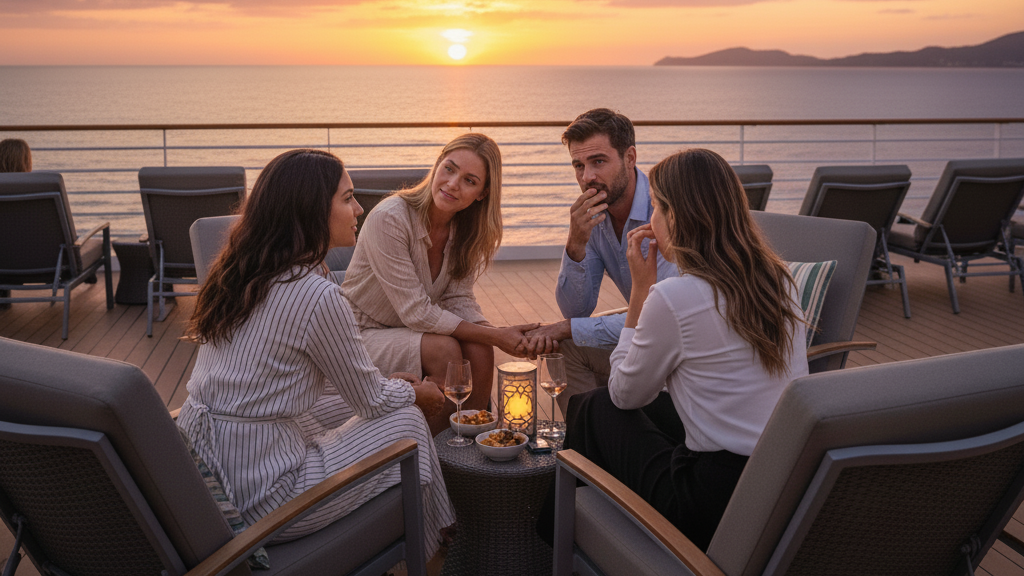
Some of the most meaningful lifestyle cruise moments happen when you least expect them: a vulnerable 2am conversation on the deck with new friends, a shared laugh about awkward first-cruise moments, a couple you connect with who just “get” you, or a moment of acceptance that heals old wounds.
These moments can’t be forced or scheduled. They arise when you show up authentically, stay present, and allow connection to unfold naturally. Your job isn’t to make them happen—it’s to be open when they do.
Vulnerability as the Gateway to Connection
The most memorable connections on lifestyle cruises happen when someone drops their performance and shares something real: nervousness about being first-timers, relationship struggles they’re working through, body image insecurities, or simply “I have no idea what I’m doing.”
These moments of vulnerability give others permission to be real too. The “perfect” social performances create distance; authentic vulnerability creates intimacy.
Consider sharing honestly when appropriate:
- “This is our first lifestyle cruise and we’re both nervous but excited.”
- “I have social anxiety, so if I seem awkward, that’s why—but I’m genuinely enjoying talking with you.”
- “We’re working on jealousy issues, so please be patient with us.”
- “I wasn’t sure I’d fit in here, but you’ve all made us feel so welcome.”
After the Cruise: Processing and Integration
The Post-Cruise Emotional Landscape
The days and weeks after your first lifestyle cruise can feel emotionally complex. You might experience:
- Post-cruise blues: Sadness that the experience ended and you’re back to “regular life”
- Relationship recalibration: You and your partner processing what you experienced together
- Identity integration: Reconciling your lifestyle experiences with your everyday identity
- Friendship longing: Missing the connections you made on board
- Reflection and growth: Understanding what you learned about yourself and your relationship
Give yourself time and space to process without rushing to conclusions about what it all “means.”
Debriefing with Your Partner
Schedule a dedicated conversation with your partner within a week of returning. Not a casual “that was fun” chat, but a deep debrief:
Questions to explore together:
- What moments felt most meaningful to you?
- Were there any times you felt uncomfortable or disconnected from each other?
- What surprised you about the experience?
- How do you feel about our relationship after this experience?
- What boundaries worked well? What needs adjustment?
- Do you want to do another lifestyle cruise? Why or why not?
- What did you learn about yourself? About me? About us?
This conversation strengthens your relationship by integrating the experience rather than compartmentalizing it.
Maintaining Cruise Friendships
One of the unexpected joys of lifestyle cruises is the friendships that extend beyond the ship. Unlike typical vacation acquaintances, lifestyle cruise connections often evolve into meaningful long-term friendships.
Strategies for maintaining connection:
- Social media connection: Many lifestyle cruisers have separate social profiles for lifestyle community
- Private group chats: Create a group with your cruise friends to stay in touch
- Plan reunions: Many cruise groups coordinate meetups or attend future events together
- Video calls: Schedule occasional video chats to stay connected beyond text
- Attend local events: Look for lifestyle events in each other’s cities
Don’t let the magic of cruise friendships fade simply because you didn’t know how to maintain them. These connections can become some of the most meaningful friendships of your life.
Integrating Your Experience into Daily Life
Your first lifestyle cruise may shift something in how you see yourself, your relationship, or your capacity for connection. Honor that growth by integrating what you learned:
- Increased authenticity: Can you bring more of your authentic self to everyday friendships?
- Improved communication: Can the communication skills you practiced on the cruise strengthen your daily relationship?
- Boundary awareness: Can you apply the boundary-setting you learned to other areas of life?
- Confidence growth: How can you carry the confidence you found on the cruise into regular life?
The lifestyle cruise isn’t separate from your “real” life—it’s an amplified version that can teach you about who you are and what you’re capable of.

Final Thoughts: Preparing Your Heart for the Journey
The logistics of your lifestyle cruise—what to pack, which cabin to book, how to navigate theme nights—are important, but they’re not what will make your experience meaningful. What matters most is showing up with an open heart, realistic expectations, and willingness to be vulnerable.
Your first lifestyle cruise won’t be perfect. You’ll have awkward moments, experience nervousness, possibly face jealousy or insecurity, and definitely step outside your comfort zone. These aren’t signs you’re doing it wrong—they’re evidence you’re growing.
The connections you make, the acceptance you feel, the vulnerability you share, and the authenticity you discover about yourself and your partner—these are the gifts of lifestyle cruising. The emotional journey is the real destination.
Trust yourself. Trust your partner. Trust the process. The lifestyle community will meet you with acceptance and support. You’re ready for this—not because you have all the answers, but because you’re brave enough to explore the questions.
Frequently Asked Questions About Lifestyle Cruise Social & Emotional Aspects
What if I’m too nervous to talk to anyone on my first day?
First-day nervousness is universal among lifestyle cruisers, even veterans attending new cruises. Give yourself permission to just observe on Day 1. Sit in social spaces, smile at people, and let conversations come to you naturally. Most people will introduce themselves, and you can simply respond rather than initiating. By Day 2, you’ll feel more comfortable as the environment becomes familiar. Remember: everyone else is also looking for connections and will be relieved when you engage with them.
How do I handle jealousy if it unexpectedly surfaces during the cruise?
Jealousy on lifestyle cruises is extremely common and doesn’t mean you’ve failed or aren’t “cut out” for this. Use your pre-arranged signal to let your partner know you need reconnection time. Step away to a quiet space for 10-15 minutes to breathe and process. Then communicate honestly: “I know we agreed to this, but I’m feeling vulnerable right now and need reassurance.” Your partner will understand—they may have felt the same at some point. Jealousy is information about your needs, not a judgment on your relationship or the lifestyle.
What if my partner connects with people more easily than I do?
Different social speeds are common in couples. If your partner is naturally more outgoing, discuss a strategy beforehand: they can introduce you into conversations, stay by your side in new social settings, or help you feel included. It’s also okay to do some activities separately—your partner can socialize while you recharge, then reconnect later. Many successful lifestyle couples have different social styles and make it work by communicating and supporting each other’s needs.
How do I politely decline someone without feeling guilty or hurting their feelings?
The lifestyle community values direct, honest communication. A simple “Thank you for the invitation, but we’re not feeling a connection” or “We appreciate you saying hello, but we’re enjoying chatting just the two of us tonight” is perfectly acceptable and expected. Most people will respond with “No problem, enjoy your cruise!” because they understand rejection is part of the social dynamic. You’re not responsible for managing their emotions—clear communication is actually the kindest approach.
What if we don’t connect with anyone during the entire cruise?
While rare, it’s possible to attend a cruise and not find your “people.” This doesn’t mean you failed—it means chemistry and compatibility are complex. Consider: Were you attending structured activities where connections naturally form? Were you staying in your cabin too much? Did nerves keep you from engaging fully? Sometimes the first cruise is about learning the ropes, and deeper connections happen on subsequent cruises when you’re more comfortable. Even if you don’t connect romantically or sexually, many first-timers make platonic friendships that feel valuable.
How do I deal with insecurity about my body or appearance?
Body diversity on lifestyle cruises is one of the most liberating aspects—you’ll see all body types, ages, and appearances. The people who thrive aren’t the most conventionally attractive; they’re the most confident and authentic. Focus on what your body allows you to experience rather than how it looks. Dress in ways that make you feel good. Remember that attraction is about chemistry, energy, and connection—not meeting conventional beauty standards. Many people report that lifestyle cruises actually heal body image issues because they experience acceptance they didn’t expect.
What if the experience changes my relationship in unexpected ways?
Lifestyle cruises can indeed impact relationships, usually in positive ways—increased communication, deeper trust, renewed excitement—but sometimes they reveal incompatibilities or different desires. If you notice relationship shifts during or after the cruise, don’t panic. Schedule time to debrief together, possibly with a lifestyle-friendly therapist if needed. Many relationships grow stronger through the experience of navigating new territory together. The key is processing together rather than avoiding difficult conversations.
Related Lifestyle Cruise Resources:
- Adult Lifestyle Cruises: What to Expect on Your First Voyage (comprehensive guide)
- Complete Lifestyle Cruise Packing List
- Theme Night Planning for Lifestyle Cruises
- Lifestyle Cruise Etiquette and Unwritten Rules
- Couple Dynamics on Lifestyle Cruises
