
There’s a tension at the center of travel photography without missing the moment that most photography guides pretend doesn’t exist. You want to remember the place. You also want to actually be in it. And the more seriously you take the photography — composing the shot, finding the angle, adjusting the exposure, checking the result — the more you’ve slipped into documentation mode and out of experience mode, often without noticing.
This guide is for people who’ve come home from a trip with a full camera roll and a nagging sense that they were slightly absent from the thing they photographed. It covers real photography technique — composition, light, smartphone settings — but it leads with the harder problem: how to take photos that are worth having without letting the taking of photos consume the trip itself.
Quick Takeaways:
- Designating one person as the photographer for a given activity works better than both people half-attending while intermittently shooting
- The presence-vs-documentation tension is real and worth addressing with explicit decisions, not just good intentions
- A “one and done” rule — one good shot, then phone away — works better in practice than “I’ll just take a few”
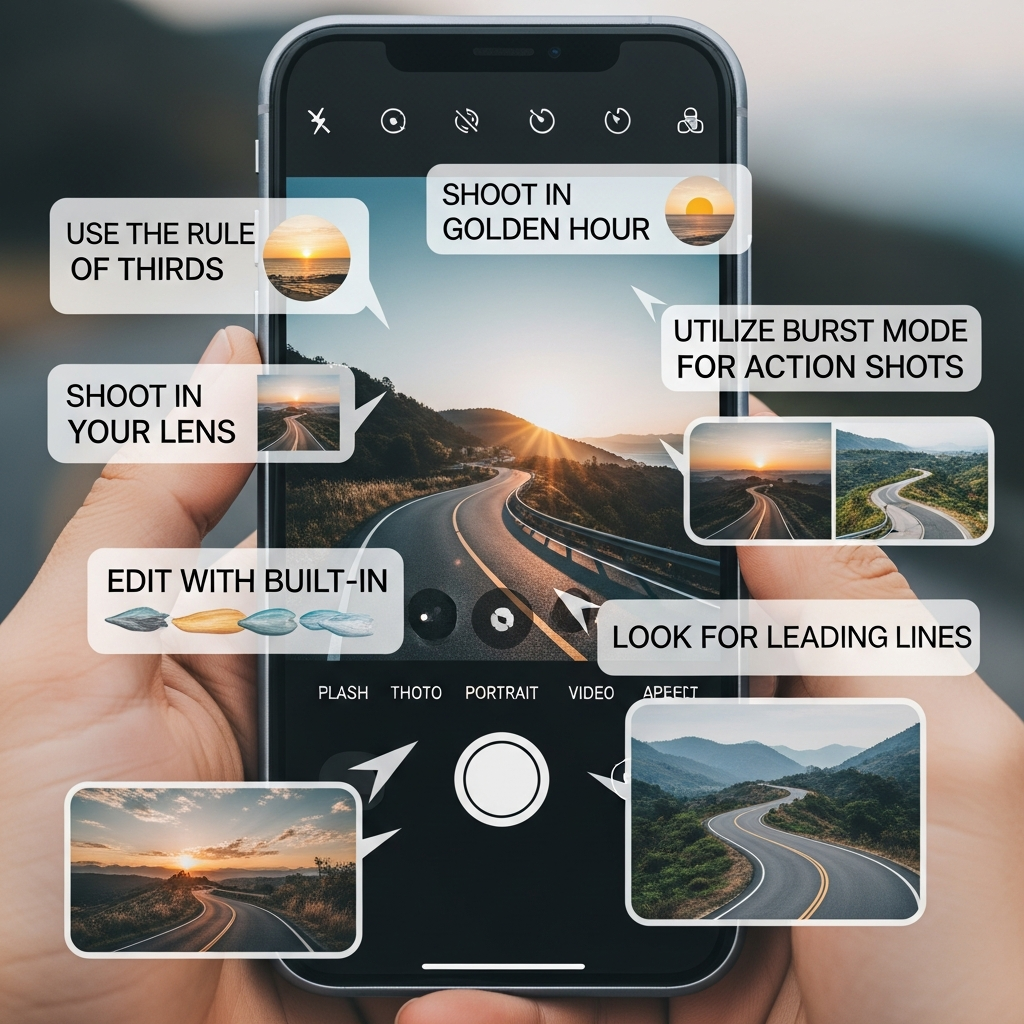
- Golden hour (the hour after sunrise and before sunset) produces dramatically better photos with the same effort, reducing the time you need to spend shooting to get results worth keeping
- Clean your lens before every shoot — it’s the single most impactful technical habit for phone photography
- The shots that actually transport you back to a place ten years later are rarely the landmark photos — they’re the details, the meals, the people you were with
Table of Contents
The Presence Problem: Why Photography and Travel Conflict
Travel photography advice almost always treats the photography as the primary thing and presence as a secondary concern to be managed. That framing is backwards for most travelers. The primary thing is the experience. The documentation is in service of that.
The issue is that the brain doesn’t multitask well between documentation mode and experience mode. Documentation mode is forward-looking and evaluative: is the framing right, is the light good, should I take another one. Experience mode is present and receptive: what is this place, what does it feel like, what’s happening around me. Switching between them is possible, but staying in one tends to crowd out the other.
Studies on memory and photography add an interesting complication: the act of photographing something can actually reduce how well you remember it, because the outsourcing of memory to the camera reduces the depth of encoding in your own brain. The photo exists; the memory is shallower. This isn’t a reason not to photograph — it’s a reason to photograph intentionally rather than reflexively.
The Reflexive Shot vs. the Intentional Shot
Most travel photos are reflexive: you see something, you reach for the phone, you shoot, you pocket the phone. The composition wasn’t considered, the light wasn’t evaluated, the shot wasn’t really decided on — it just happened. Reflexive shots produce a camera roll of 300 photos from a week-long trip, most of which you’ll never look at and none of which really capture what the place was like.
Intentional shots involve a brief pause: deciding this is worth a photo, taking a moment to frame it, shooting once or twice deliberately, and then genuinely putting the phone away. You’ll take fewer photos. They’ll be better. And you’ll spend more of the trip actually in the place you’re visiting.
The practical transition from reflexive to intentional photography isn’t a philosophical shift — it’s a habit change. The most useful habit: after taking a photo, actively decide to put the phone away. Not “I’ll just check this one” — physically pocket or bag it. The checking pulls you back into documentation mode and the cycle continues.
Making Actual Decisions About Phone Use
Every couple or travel group going on a trip intends to be present. Almost none of them make actual decisions about what that means in practice. Intentions evaporate. Decisions are different.
Decisions that work:
- “No phones during meals” — the meal is the experience; photograph the food when it arrives, then put the phone away
- “One person photographs, the other is fully present” — designate a photographer for a given activity, rotate roles across the trip; the photographer documents, the non-photographer is genuinely present, both benefit
- “Photos get taken, then the phone goes away for 20 minutes” — gives a defined period of genuine experience after each documentation moment
- “No shooting during the thing, only before and after” — watch the sunset, not your screen; photograph the setup and then just be there
None of these is the right answer for everyone. The right answer is whichever one you actually agree to and actually do.
How to Take Better Photos With Less Effort
The fastest way to reduce the time you spend taking photos is to get better results with fewer shots. Better technique means you don’t need to take thirty shots hoping one is good. You take three, one is good, and you move on.
The Single Most Impactful Habit: Clean Your Lens
Before you do anything else on this list: take a microfiber cloth or your shirt, and wipe your phone camera lens. Do this before every intentional shoot. A smudged lens — from fingers, pocket lint, humidity — produces hazy, soft images that no amount of editing recovers. This takes two seconds and affects every single photo you take. Nothing else on this list produces a bigger improvement for less effort.
Light Is Everything — Specifically, Golden Hour
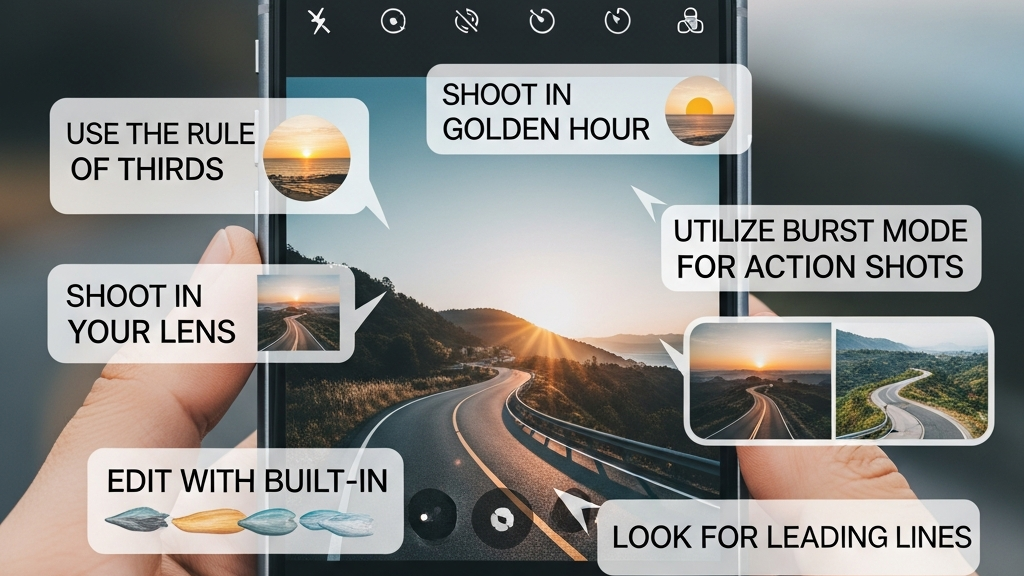
The hour after sunrise and the hour before sunset are called golden hour because the light is warm, directional, and soft rather than harsh. Photographed during these windows, almost anything looks good. Photographed at midday, the same scenes look flat, washed-out, or harshly shadowed.
For travel photography without missing the moment, this is the most time-efficient technique there is: schedule your significant photography around golden hour, and use the middle of the day for activities where you’re not trying to get great shots. You’ll spend less time shooting and get better results.
Practically: identify the one or two things you most want to photograph on a given day. Time your visit to those things for the hour after sunrise or the hour before sunset. For everything else, take the photo if you want it and don’t worry about optimizing.
Cloudy days are also underrated for photography — overcast light is soft and even, with no harsh shadows. It’s not as warm as golden hour, but it’s better than midday sun for portraits, architecture, and food.
Composition: The One Rule Worth Learning
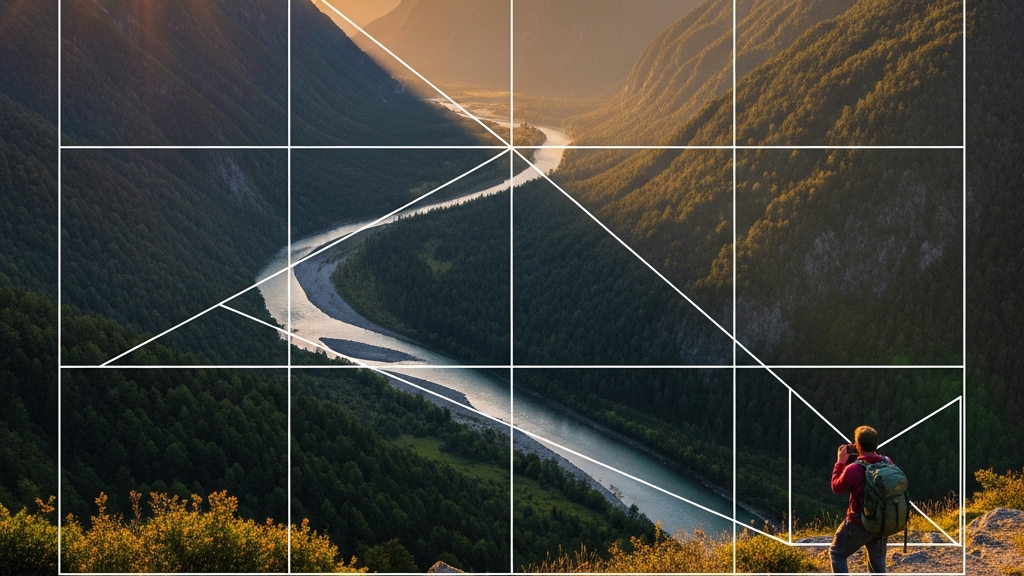
If you only learn one composition principle, learn the rule of thirds. Enable the grid overlay in your phone’s camera settings — it divides the frame into a 3×3 grid of nine equal sections. Place your main subject at one of the four intersection points rather than centered. Place horizons on the top or bottom third rather than the middle. That’s it. Most travel photos that look amateurish are centered; most that look considered aren’t.
Two additional principles worth knowing:
- Leading lines: Roads, paths, shorelines, fences, and architectural edges that draw the eye toward your subject create depth and direction in a photo. When you see a natural line in the scene, consider whether positioning yourself so that line leads toward your subject improves the shot.
- Something in the foreground: Including an element in the immediate foreground — flowers, rocks, a table, a railing — creates a sense of depth that flat, foreground-empty shots lack. This is especially useful for landscapes that would otherwise look flat.
Phone Settings That Actually Matter
You don’t need to go deep into camera settings to improve your photos significantly. The ones worth knowing:
- Enable grid lines (in camera settings) for rule-of-thirds composition guidance
- Tap the screen to focus and expose on what matters — your phone doesn’t always guess correctly. Tapping locks focus and sets exposure for that element.
- Portrait mode for photos of people — creates the background blur that makes subjects stand out
- Night mode for low-light situations — modern phones handle this remarkably well; flash almost never produces better results
- Don’t use digital zoom — it degrades image quality significantly. Move closer instead, or accept the wider framing and crop in editing.
Stabilization Without a Tripod
Blurry photos usually come from camera movement during the shot. Hold the phone with both hands, tuck your elbows against your body, and press the volume button as the shutter rather than tapping the screen (which introduces movement). Finding a stable surface — a wall, a railing, a table — and resting the phone against it enables sharper shots in low light than handheld shooting allows.

What to Photograph: The Shots You’ll Actually Value Later
The photos that matter most ten years later are rarely the landmark shots — the Eiffel Tower, the beach sunset, the mountain vista. You’ll have those photos and you’ll almost never look at them. The photos you actually return to are the specific ones: the meal you had on the second night, the detail of the doorway on that side street, the expression on your travel companion’s face at a moment that made you both laugh.
Document the Details
The details of a place are often more evocative than its icons. The mosaic pattern on a restaurant floor, the handwritten menu board, the way the light came through a window in the morning, the texture of a market vendor’s display. These images don’t require perfect composition or golden hour light — they just require noticing and shooting quickly. They’re also much less photographed, which means they have more distinctiveness and more GIST value as memories.
Photograph the People You’re With
This is the category most commonly skipped and most regretted later. Candid photos of your travel companions — not posed, not “say cheese,” but genuine moments of engagement, reaction, and interaction — are the most valuable travel photos for almost everyone. They require no special technique: just notice when someone you’re with is doing something genuinely themselves, and shoot before they notice.
The “Story” Shot Set
For any experience worth documenting, a set of three images tells more than any single shot:
- The establishing shot — wide, shows the context and setting
- The detail shot — close, shows something specific within it
- The human shot — includes a person (you, your companion, a local) and creates emotional connection
Three deliberate shots that tell a story are more valuable than thirty reflexive shots of the same scene from the same angle.
What to Skip Photographing While Traveling
This is underrepresented in photography guides: knowing when not to photograph is as important as knowing how.
- The thing you’ve already photographed multiple times. One good shot of the Colosseum is better than thirty. After you have it, put the phone away and look at it.
- Moments that are defined by their feeling rather than their appearance. The best conversation you had on the trip. The sunset you watched in silence. Some experiences encode better when you’re fully in them.
- Religious or sacred spaces where photography disrupts the atmosphere. Even when it’s technically permitted, a long lens pointed at people in prayer changes the space. Use judgment, not just rules.
- Every plate of food at every meal. Select. Document the ones that are actually remarkable. Let the others be meals rather than content.
Basic Editing: What Actually Helps
Editing is where many travel photos go wrong — not because the edits are bad, but because they’re too much. Heavy filters date photos quickly and visually overpower what was actually there. The goal is to make the photo look more like what you saw, not more dramatic than it was.
The edits that genuinely help:
- Exposure: Brighten photos that came out dark, particularly in shade or indoor settings
- Straighten: A slightly crooked horizon is distracting; fix it in the crop tool
- Saturation +10–15%: A modest boost makes colors look like what you remember without looking artificial
- Sharpening: A small amount adds clarity; too much looks crunchy
Free apps worth knowing: Snapseed handles all of the above well and is genuinely powerful. The native iPhone or Android photo editor handles the basics acceptably for most purposes. You don’t need to buy anything.
The most important editing habit: keep the original. Edit a copy. Your phone does this automatically in most apps, but verify before you apply anything irreversible.
Backing Up: Don’t Lose What You’ve Taken
Enable automatic cloud backup before you leave home. Google Photos (free for high-quality storage) and iCloud (for iPhone) both back up automatically over WiFi. Use your hotel or accommodation WiFi each night to let the backup run. A phone that is lost, stolen, or dropped in the ocean should not also mean lost photos.
For trips where you’re taking photos that matter — a once-in-a-lifetime trip, a significant event — consider backing up to a second location (a small portable drive, or a second cloud service) rather than relying on a single backup. The redundancy costs five minutes and protects against the unlikely but real scenario of a cloud account issue.
Conclusion: Document Well, Be There More
The resolution to the presence-vs-documentation tension in travel photography without missing the moment isn’t choosing one over the other — it’s being deliberate about both. Intentional photos, taken with some technique and then genuinely put away, produce better memories and better photography than reflexive shooting that never quite ends.
Clean lens. Golden hour when it matters. Rule of thirds. One good shot then phone away. That’s most of it. The rest is deciding — actually deciding, not just intending — to be in the place you traveled to see.
Frequently Asked Questions: Travel Photography Without Missing the Moment
How do I stop spending so much time on my phone during trips?
Make explicit decisions rather than setting intentions. u0022I’ll be more presentu0022 doesn’t work — u0022phone goes in my bag after every photo and stays there for at least 15 minutesu0022 does. The decision creates a structural change; the intention doesn’t. If you’re traveling with others, designate a photographer for each activity and rotate — the non-photographer is genuinely off duty from documentation and can be fully present.
Do I need a real camera, or is my phone good enough?
For most travelers, a recent-generation smartphone is more than good enough. The technical ceiling of modern phone cameras exceeds the technical ceiling of most people’s photography skills — the limiting factor is almost never the hardware. A dedicated camera offers advantages in specific situations (wildlife at distance, extreme low light, very long zoom) but for typical travel photography, the phone you already have is the right tool. The best camera is the one you use without thinking about the camera.
What’s the single most important photography habit to develop?
Deciding before you shoot rather than after. Before raising the phone, make a brief conscious decision: this is worth a photo. Then frame it, take one or two shots, and put the phone away. This prevents the reflexive spray-and-pray approach that produces 300 mediocre photos and doesn’t actually help you remember or document anything better than 30 intentional ones would.
How do I get better photos of people without it being awkward?
The awkwardness usually comes from the process — pointing, waiting, u0022okay say cheeseu0022 — rather than from the fact of the photo. Candid shots (taken while people are engaged in something, not aware of the camera) are almost always better than posed ones. Shoot before they notice you’re shooting. If you want to photograph strangers, a quick smile and a gesture toward your camera is usually sufficient — and if they indicate no, move on without pressure.
Should I post photos during the trip or wait until after?
This is a personal choice, but posting during the trip has a specific cost: it pulls you into audience-awareness mode (what will people think of this photo?) rather than experience mode (what is this place actually like?). Many travelers find that batching and posting after they return produces better posts and a better trip. Others find that the act of sharing is part of the experience. Be honest with yourself about which one is actually true for you.
What makes a travel photo worth keeping?
It transports you back to the experience rather than just documenting that you were present. The test: looking at it five years from now, does it make you feel something about the place or the moment? Or does it just confirm that you stood near a famous thing? The former is worth keeping. The latter is one of the reasons your camera roll has 4,000 photos you never look at.
Related Resources:
- International Travel for First-Timers: What Nobody Warns You About
- First-Time Cruise Tips: What to Know Before You Book
- Couples Vacation Planning: When You Want Different Things
- Beach Vacation Planning for Couples
External Resources:
- National Geographic Photography — professional techniques, composition examples, and visual storytelling from one of the world’s most respected photography publications
- Digital Photography School — practical tutorials on composition, lighting, and smartphone photography for non-professionals
- Snapseed — free, powerful mobile photo editor with tutorials for basic and advanced editing
