
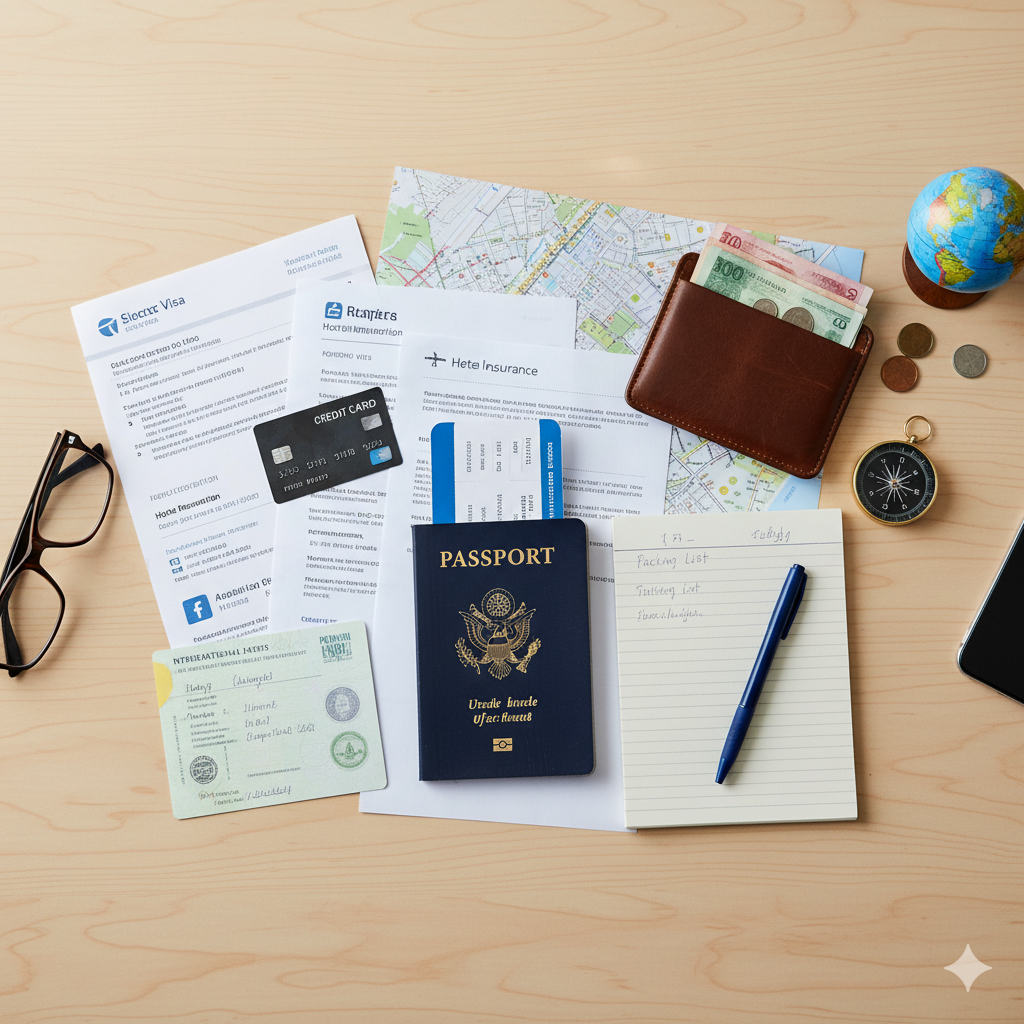
Every guide for international travel for first timers covers the same checklist: apply for your passport early, pack an adapter, download Google Translate, be aware of your surroundings. That information is correct and easy to find. This guide covers the part that isn’t — the specific scams, financial traps, and situational mistakes that catch first-time international travelers off guard precisely because they’re never in the standard guides. The people who know about them learned by experience. You don’t have to.
We’ll cover the foundational logistics too — passport rules, currency, documentation — but the emphasis here is on what the brochures skip: how tourist scams actually work, which financial decisions quietly cost you hundreds of dollars, and what the cultural missteps are that nobody thinks to warn you about until it’s awkward.
Quick Takeaways:
- Dynamic Currency Conversion (DCC) is one of the most common financial traps in international travel — always choose to pay in local currency, never your home currency, at every ATM and card terminal
- The fake police scam operates in more countries than most travelers realize — real police almost never demand your passport on the street
- Airport currency exchange booths can charge 10–15% above the real rate; use a bank ATM at your destination instead
- Most countries require your passport to be valid 6 months beyond your return date — not just until you land
- The “attraction is closed today” redirect scam targets first-timers specifically because they don’t know the real situation
- Tipping culture varies dramatically and getting it wrong goes both ways — over-tipping can be as culturally strange as under-tipping
Table of Contents
The Scams and Financial Traps That Target First-Time Travelers
This section leads because it’s the one first-time international travelers most consistently wish they’d read before leaving. These aren’t rare edge cases — they’re common, practiced, and specifically designed to work on people who don’t know to look for them.
Dynamic Currency Conversion: The Invisible 5–10% Tax
This is the most financially significant trap in international travel and the one most commonly missed because it looks like a helpful option. When you use your card at an ATM or card terminal abroad, you’ll often see a screen offering to charge you in your home currency (US dollars, for example) instead of the local currency. The screen may say something like “Would you like to pay in USD for your convenience?” or show you the conversion with a big green checkmark.
Always decline this. Always choose local currency.
Dynamic Currency Conversion allows the merchant or ATM operator — not your bank — to set the exchange rate, and they set it badly. The markup is typically 3–8% above the real rate, sometimes higher. Your own bank’s foreign transaction fee (if you have one) is usually 1–3%. You’re choosing between paying your bank’s rate plus their fee versus paying an inflated rate that benefits neither you nor your bank. Every time you see that option, declining it is the correct choice, with zero exceptions.
This applies to:
- ATM withdrawals — when asked “be charged in USD or local currency,” choose local currency
- Restaurant and hotel card terminals — same screen, same answer
- Rental car companies — particularly aggressive about this; confirm local currency before signing
- Tour operators and shops — any time a card terminal gives you the option
The Fake Police Scam
This operates in various forms across Europe, Asia, Latin America, and elsewhere, and it targets tourists specifically. The most common version: one or two people approach you on the street, identify themselves as plain-clothes police officers, and ask to inspect your wallet, passport, or bag — usually claiming they’re investigating counterfeit currency or drug trafficking in the area.
They are not police. Real police almost never stop civilians on the street to demand passport or wallet inspections without a specific documented incident. If it happens to you: do not hand over your wallet or open your bag. Ask to go to the nearest police station or the nearest marked police officer in uniform. Genuine officers will take you there without resistance. The fake ones will drop the act and leave.
Variations include:
- Someone showing a badge briefly and claiming your currency may be counterfeit — they want to “check” it for you
- A person in casual clothes claiming to be an undercover officer investigating the restaurant or vendor you just used
- A “police checkpoint” at a suspicious location (not an official border or checkpoint) demanding documentation and a fine for a fabricated infraction
The consistent thread: they want something in your hands to become something in their hands. The countermeasure is to never hand over documents or money outside a formal, official setting you initiated or can verify.
The “Attraction Is Closed Today” Redirect
You’re walking toward a major attraction — a temple, museum, palace — and someone intercepts you on the approach. They look official enough, or at least confident. They tell you the attraction is closed today (national holiday, private event, renovation). But they know somewhere nearby that’s just as good, or better, and they’ll take you there.
The attraction is not closed. The “somewhere nearby” is a shop where the person earns commission on whatever you spend.
This scam works on first-timers specifically because they don’t have the local knowledge to immediately know it’s false. The countermeasures are simple: ignore anyone who intercepts you before you reach a venue, verify closure directly at the entrance or on the official website, and treat any unsolicited guidance toward an alternative as a red flag regardless of how convincing the delivery is.
The Friendship Bracelet and Petition Scams
The friendship bracelet scam: someone approaches and ties a bracelet onto your wrist or places something in your hand before you can decline. Once it’s on or in your possession, they demand payment. The psychological mechanism is that having accepted the object (even involuntarily) creates a sense of social obligation to pay for it.
The countermeasure: keep your hands in your pockets or simply keep moving. If something is placed on your wrist, you are under no legal or moral obligation to pay for it. Remove it and walk away.
The petition scam often operates alongside pickpocketing. Someone approaches with a clipboard asking you to sign a petition for a cause. While you’re reading and signing, an accomplice goes through your bag or pockets. The petition is meaningless; the goal is your attention being absorbed while your hands are occupied.
A version of this uses a child or young person presenting a petition or asking for help with a homework project, which is more disarming. The mechanics are the same. Keep your bag closed and in front of you whenever someone approaches you in a tourist area.
Overcharging Taxis and “Meter Broken” Claims
This is one of the oldest scams in international travel and still one of the most common. The driver either doesn’t turn on the meter, claims the meter is broken and quotes an inflated flat rate, or drives a significantly longer route than necessary. All three are most likely to happen when you’re clearly a first-timer at an airport or major transit hub.
Countermeasures: use ride-hailing apps (Uber, Bolt, Grab, or local equivalents) where the price is set before you get in. If you must take a street taxi, agree on a price before entering the vehicle, not after. Know the approximate fare from the airport to your hotel before you land — a quick search of “[city] airport taxi to city center cost” takes two minutes and saves you from being charged three times the real rate.
The “Too Good to Be True” Currency Exchange
Someone on the street or in a market offers to exchange currency at a dramatically better rate than the official rate. The mechanisms for how this ends badly range from receiving counterfeit notes, to short-changing you in the exchange, to the exchange being interrupted at a key moment that leaves you with less than you handed over. Street currency exchange is illegal in many countries for exactly these reasons.
Use a bank ATM. The rate will be better than any street rate, the transaction is secure, and you receive legal, verifiable currency.
Financial Fundamentals: What to Know Before You Land
The ATM Is Your Best Tool — Used Correctly
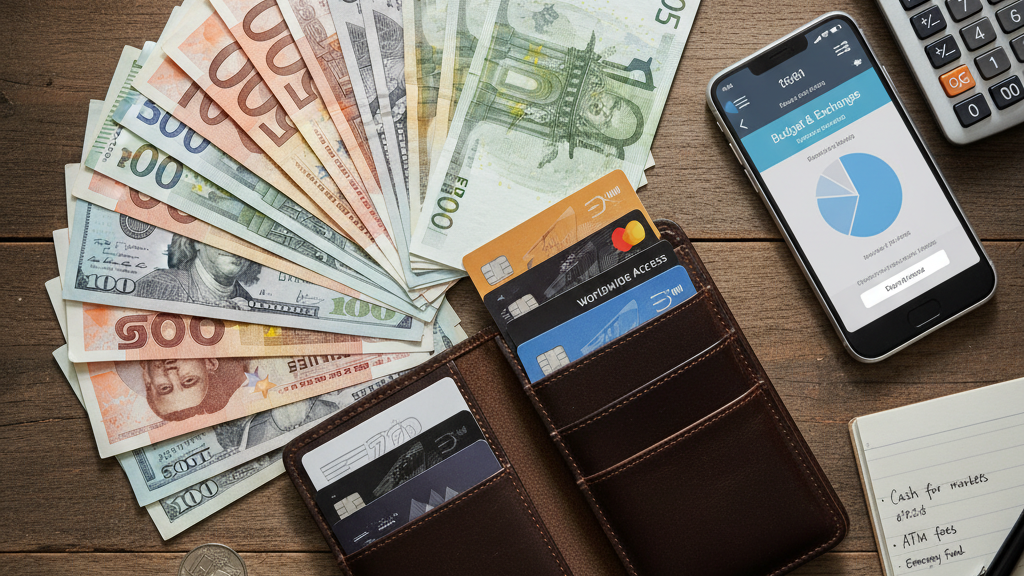
For international travel for first timers, ATMs attached to actual banks are the best way to access foreign currency. The rate you get is the interbank rate — the real exchange rate — plus your bank’s fee, which is typically much lower than any currency exchange service.
Practical rules:
- Use bank-attached ATMs, not standalone machines in convenience stores or tourist areas. Standalone machines often charge higher fees and are more likely to have been tampered with by skimmers.
- Withdraw larger amounts less frequently to minimize per-transaction fees. Two withdrawals of $200 is cheaper than four withdrawals of $100.
- Always choose local currency when the machine asks (see Dynamic Currency Conversion above).
- Cover the keypad when entering your PIN regardless of where the ATM is located.
- Have your bank’s international contact number saved before you travel. If your card is blocked, you need to call them — not find out their number while standing at an ATM abroad.
Notify Your Bank Before You Leave
This is one of the most commonly skipped steps and one of the most consequential. Banks flag international transactions as potential fraud and block cards without warning. You’ll be at a restaurant or ATM, your card will decline, and you’ll have no idea why.
Before you travel: call your bank or use their app to add a travel notice with your destination countries and travel dates. Do this for every card you’re bringing. Takes five minutes per card and eliminates one of the most stressful things that can happen on a first international trip.
Cards Without Foreign Transaction Fees
Standard credit and debit cards charge 1–3% on every international transaction. Over the course of a ten-day trip, this adds up to real money. Cards specifically designed for travel — Capital One Venture, Chase Sapphire Preferred, Schwab debit card, and several others — waive these fees entirely. If you’re planning international travel regularly, having one of these cards is worth the five minutes to apply.
Airport Currency Exchange: Skip It
Airport currency exchange booths offer terrible rates — often 10–15% worse than the real rate — because they know you’re captive, tired, and may not have local currency. The one exception worth considering: getting a small amount of the local currency before landing (ordered from your bank in advance) so you have something for an immediate taxi or coffee while you find an ATM. For anything beyond that, use the ATM once you’re through customs.
Passport and Visa Documentation: The Rules That Catch People Off Guard
The Six-Month Validity Rule
This is the passport mistake that strands first-time international travelers most often. Most countries require that your passport be valid not just for your trip, but for six months beyond your return date. A passport that expires in four months is valid — but may still get you denied entry at the border of many destinations.
Check your passport expiration date against your return date and add six months. If the passport expires before that combined date, renew it before you book.
Processing Times Are Longer Than You Think
Current U.S. passport processing times fluctuate and can run six to eight weeks for routine applications, longer during peak periods. Expedited service costs an additional fee and still runs two to three weeks. Apply at least three to four months before you intend to travel — earlier if you’re booking around a peak holiday period.
If you need a passport urgently, in-person appointments at regional passport agencies are available for emergency travel within two weeks. These require documentation of your travel dates.
Document Copies: Do This Before You Pack
Before you leave:
- Photograph the bio page of your passport and email it to yourself
- Write down your bank’s international contact number (not the 800 number — those often don’t work from abroad)
- Note the address and phone number of the U.S. embassy or consulate in your destination city
- Leave a physical copy of your passport with someone at home
If your passport is stolen, having the photo page means you can prove your identity and get an emergency travel document from the consulate significantly faster. The consulate contact information means you know where to go when it happens rather than scrambling to find it.

Cultural Mistakes That First-Timers Don’t Know to Avoid
Most cultural guides are written to help you blend in. This section focuses on the specific mistakes that mark you as an uninformed tourist and — more importantly — the ones that are genuinely offensive rather than just slightly awkward.
Tipping Norms Go Both Ways
The standard advice is “research tipping customs before you travel,” and that’s correct but incomplete. The assumption is usually that you might under-tip. But in many countries — Japan most prominently, also South Korea and much of Southeast Asia — tipping is not just unnecessary but actively strange or mildly rude. It implies the server is underpaid or that you’re trying to buy their goodwill. In Japan specifically, a restaurant staff member may follow you out the door to return the tip you left.
The countries where tipping is expected behave roughly like the U.S. (15–20% in restaurants): Canada, Australia, parts of the UK. In most of Europe, a small rounding-up gesture (rounding €18.50 to €20) is appreciated but a full American-style 20% tip on top of the bill is excessive and noticed. Research your specific destination rather than applying U.S. norms everywhere.
Dress at Religious Sites
This is the single most common way first-time international travelers inadvertently cause offense. Religious sites across Asia, the Middle East, Southern Europe, and Latin America have specific dress requirements that are not always prominently posted in English. The baseline: covered shoulders and knees for both men and women. At many mosques, women are also required to cover their hair — scarves are often available to borrow at the entrance.
Wearing shorts and a tank top to a temple because it’s hot outside is not malicious, but it is noticed and it communicates something about how seriously you’re taking the space you’re in. Carry a light scarf or a pair of light pants that pack small and put them on at the entrance. This is not a significant inconvenience.
Gestures That Mean Something Different
Several common American hand gestures have different — sometimes strongly negative — meanings elsewhere:
- The “OK” sign (circle with thumb and forefinger) means something obscene in Brazil, Turkey, and parts of Southern Europe
- Thumbs up is offensive in parts of the Middle East, West Africa, and Greece
- Beckoning someone with a curled index finger (finger-wag) is rude or threatening in many Asian countries — use an open, downward-facing hand to wave someone toward you
- Pointing with a single finger is considered rude in many cultures — use an open hand or nod of the head to indicate direction
The Photography Rules Nobody Posts
Asking before photographing people is the right instinct and you should follow it. But there are less obvious photography rules that first-timers consistently violate:
- Do not photograph military installations, government buildings, or police officers in many countries — this is legally problematic in some and may trigger a significant incident in others
- Interior photography is often prohibited at religious sites even when exterior photography is fine — the signs are not always in English; when in doubt, ask or don’t photograph
- Some markets and vendors object to photography of their stalls, stock, or work — a quick gesture toward your camera before shooting is the right habit
Practical Logistics Worth Knowing
Phone and Data Options
Your U.S. carrier’s international day pass (typically $10/day) is convenient but adds up fast on a two-week trip. For longer trips, buying a local SIM card at your destination for $10–30 gives you data and often a local number for a fraction of the cost. Most modern unlocked smartphones accept foreign SIM cards. Confirm your phone is unlocked before you travel.
Download offline maps before you leave. Google Maps allows you to download specific regions to use without data. This matters most in the first few hours after landing when you haven’t sorted your SIM yet.
Arriving at the Airport: Timing and Customs
International departures require more time than domestic. Arrive three hours before an international flight — not two. The customs and immigration process on arrival at your destination can add another hour on top of what you expect. Factor this into transportation plans from the airport to your accommodation.
Customs declaration forms on arrival: fill them out completely and honestly. The question about “are you carrying more than $10,000 in cash or monetary instruments” is not about criminalizing cash — it’s a reporting requirement. Declaring currency is not a problem; failing to declare it when required is.
Health and Medical Coverage
Standard U.S. health insurance does not cover medical treatment abroad in most cases. Travel insurance with medical coverage is not optional for international travel — it’s the difference between a manageable situation and a financially catastrophic one. A medical evacuation from a remote location without coverage can cost $50,000–$100,000. Travel insurance covering the same event costs $100–200 for a typical trip.
Register with the State Department’s STEP program (Smart Traveler Enrollment Program) before travel. It’s free, takes five minutes, and means the nearest U.S. embassy knows you’re in the country if there’s an emergency.
Jet Lag: What Actually Works
The strategies that have actual evidence behind them: get onto destination time as quickly as possible (eat and sleep on the destination schedule, not your home schedule), get natural light during destination daytime, and stay hydrated — dehydration significantly worsens jet lag symptoms. Melatonin taken at the destination bedtime helps some people shift their sleep schedule faster.
What doesn’t work: trying to stay on your home schedule for “a day or two to ease in.” This extends the adjustment rather than shortening it.
Frequently Asked Questions: International Travel for First Timers
How do I know if a taxi is legitimate versus a scam?
Use ride-hailing apps wherever they operate — Uber, Bolt, Grab, or local equivalents. The price is set in advance and the route is tracked. For street taxis, agree on a price before getting in. Look for licensed taxis with visible identification numbers and a working meter. At airports, use the official taxi queue rather than approaching drivers who approach you in the arrivals hall — the latter are disproportionately scammers.
What should I do if someone tries the fake police scam on me?
Do not hand over your wallet, passport, or any documents. Ask to be taken to the nearest police station or to speak with a uniformed officer. Real police will comply without resistance. You can also say u0022I need to call my embassyu0022 — genuine officers have no problem with this. The fake ones will typically abandon the situation quickly once they realize you aren’t going to comply.
Is it safe to use ATMs in other countries?
Yes, with standard precautions: use ATMs physically attached to bank branches rather than standalone machines, cover the keypad when entering your PIN, check for anything loose or unusual on the card slot before inserting your card (skimmers are sometimes attached over real card slots), and do your withdrawals during daylight hours in populated areas. Bank-attached ATMs in tourist-frequented areas of most developed countries are as safe as ATMs at home.
Do I need travel insurance for international trips?
Yes. U.S. health insurance typically doesn’t cover treatment abroad. Emergency medical evacuation without insurance costs tens of thousands of dollars. Travel insurance covering medical emergencies, evacuation, and trip cancellation costs $50–200 for a typical trip depending on destination and trip value. Purchase it when you book — not the day before departure — to get the full benefits including pre-existing condition coverage and trip cancellation from the booking date.
What’s the single most common mistake first-time international travelers make?
Skipping the bank notification. Forgetting to tell your bank you’re traveling internationally means your card gets blocked for suspected fraud at the worst possible moment — usually your first purchase after landing. Call or use your bank’s app to add a travel notice with your destinations and dates for every card you’re bringing. It takes five minutes and prevents one of the most stressful things that can happen on a first international trip.
Should I exchange currency at the airport?
Only enough for immediate needs, and even then, only if you can’t get to an ATM quickly after landing. Airport currency exchange rates are consistently 10–15% worse than the interbank rate. Order a small amount from your own bank before departure if you want to arrive with local currency — they offer much better rates. For everything else, use a bank ATM at your destination.
Conclusion: What Makes the First International Trip Worth Taking
The logistics of international travel for first timers are genuinely manageable once you know what to watch for. Passport in order, bank notified, travel insurance purchased, scam mechanics understood. None of this is complicated — it’s just information that’s easy to have in advance and harder to recover from when you don’t.
The first international trip is disproportionately memorable not because of the destination but because of the novelty — everything from the currency to the road signs to the smells of a market you’ve never been to before is new simultaneously. That experience doesn’t diminish with preparation. It improves with it, because you’re not spending mental energy managing preventable problems.
The things that go wrong anyway — the wrong train, the miscommunicated restaurant order, the lost afternoon because you took a wrong turn — are the parts you’ll tell stories about. The scams and financial traps in this guide are not.
Related Resources:
- First-Time Cruise Tips: What to Know Before You Book
- Cruise Packing Guide: What to Bring and What to Leave Home
- Resort Tipping Etiquette: What to Tip, When, and Why It Matters
- Travel Photography Without Missing the Moment
External Resources:
Smart Traveler Enrollment Program (STEP) — free embassy registration for Americans traveling or living abroad
U.S. Department of State — Travel — official passport application, visa requirements, travel advisories, and STEP enrollment
CDC Travelers’ Health — destination-specific health advisories, vaccination recommendations, and disease outbreak notices
